SERVICES
How to start an IT consulting business
The first steps to start an IT consulting business for small companies, what costs money at the start, and a site you can copy.
THE EXAMPLE ON THIS PAGE
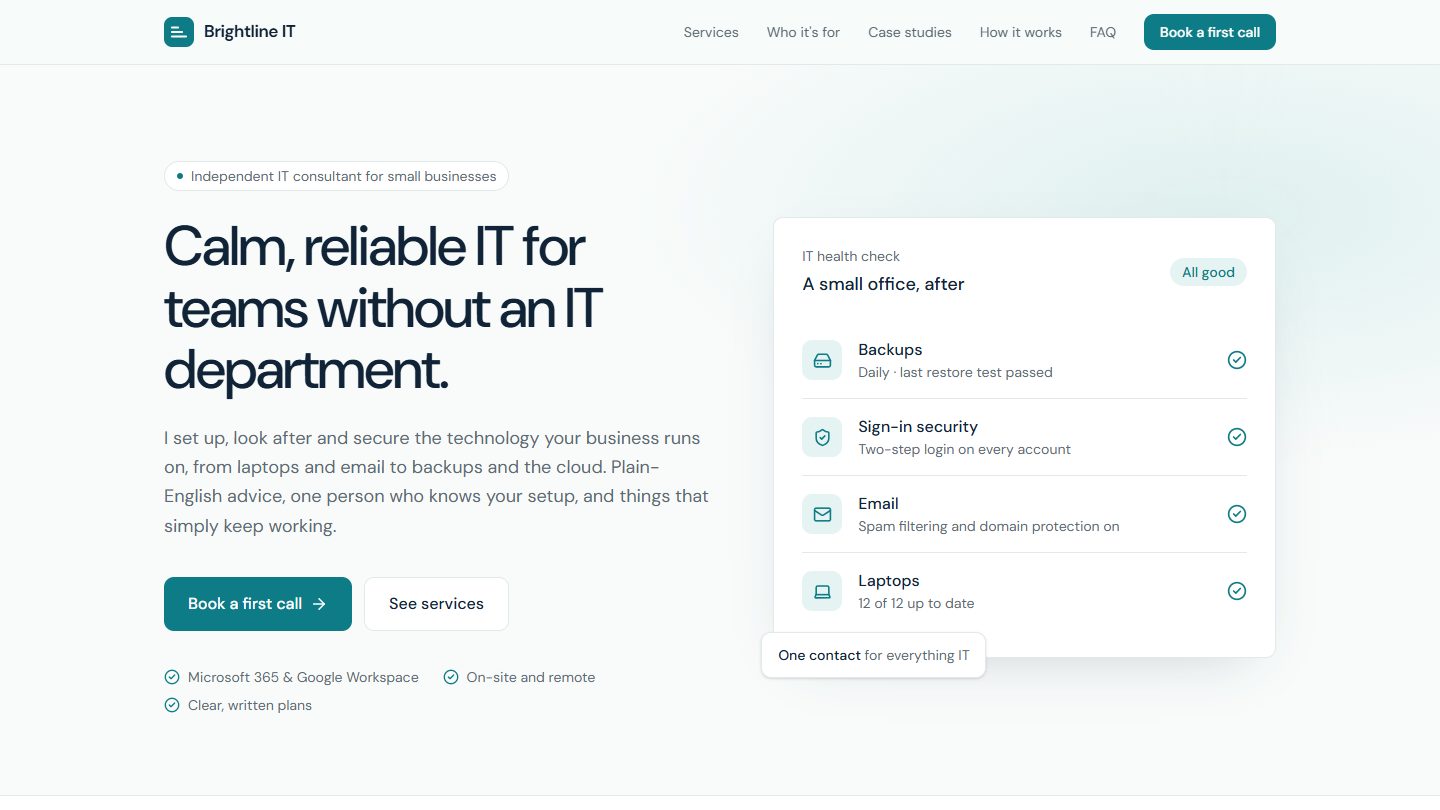
Site for an IT consulting business. An IT consultant's site with services for small businesses, short case studies and a form to book a first call.
- TIME TO A FIRST VERSION
- About 2 minutes (149 seconds, one build)
- COST TO A FIRST VERSION
- 1 build (a Free account has 3)
- DIFFICULTY
- Easy
- BEST FOR
- IT professionals going independent and serving small businesses
How to start an IT consulting business: the first steps
- 1.Pick who you help and with what. Small offices, shops, clinics or start-ups each need different help. Choose one kind of client and the three or four problems you solve best for them.
- 2.Set up the business. Register the business the way your country asks and look at professional liability insurance, since you will touch clients' systems and data.
- 3.Decide how you charge. By the hour, by the project or a monthly support plan per person or device. A monthly plan gives steadier income; write down what it covers.
- 4.Write down how you handle access and data. Clients trust you with passwords and files. A short written process for access, backups and what happens when you stop working together builds trust.
- 5.Make the first call easy to book. Owners want to understand what you do in plain words and book a call. A page with your services, short case studies and a booking form does that.
WHAT COSTS MONEY AT THE START
- A laptop and the tools and licences you use
- Business registration and insurance
- Certifications, if your clients ask for them
- A website: the example on this page takes one build on Conquer
WHAT YOU NEED
- A password manager and a remote support tool
- A written agreement for each client
- A way to send invoices and take payment
- A page with your services and a form to book a first call
Amounts are left out on purpose: they differ by country and change. Rules on registration, insurance and licences differ by place too, so check your own.
The problem
Many small businesses have regular IT needs (email, backups, laptops, security) but not enough work to hire someone full time. They want one person they can call, who deals with the owner directly and explains things plainly.
“The sweet spot is any company large enough to have regular, ongoing IT/Data needs, but not large enough to have a full-time staff dedicated to the role. This conveniently means that I also work directly with the owners and decision makers, which cuts out a tremendous amount of friction.”
How many customers look for this
Searches by people who want to buy what this business sells: a sign of demand from your future customers.
| SEARCH | PER MONTH |
|---|---|
| managed it services | 22,200 |
| it consulting services | 4,400 |
| it support for small business | 4,400 |
Average monthly Google searches in the United States, from OpenSEO (November 2026). A "near me" search counts every town, so one town sees a small share of it. Similar searches overlap, so do not add them up.
What people use today
- Managed service providers. Local IT firms that support businesses for a monthly fee per user or device.
- Upwork. Freelance marketplace where businesses hire IT help on hourly or fixed-price contracts.
- A LinkedIn profile. Where clients check a consultant, but with no services, prices or booking.
Should you build this?
REASONS TO BUILD IT
- Small businesses keep a consultant they trust for years, so each client brings repeat work.
- You can start from home with the skills you already have.
REASONS NOT TO
- Being on call for urgent problems is hard to fit around other clients.
- Clients compare you with large firms that offer contracts and cover.
How we built it, and what broke
PROMPT 1
A site for an independent IT consultant who helps small businesses. It shows the services (IT setup and support, email and Microsoft 365 or Google Workspace, backups and security, moving to the cloud), who it is for, three short case studies with the problem and the result, how a first project goes in three steps, reviews and answers to common questions. Add a form to book a first call: name, company, email, phone, the number of people in the company, what they need help with and when suits them.
Built first time in 149 seconds with one automatic repair turn, in 16 files and Conquer's Clinic style: one page with the services, who it is for, three short case studies, three steps for a first project, reviews, common questions and a form to book a first call.
- The first build failed a check and Conquer fixed it in one automatic repair turn, included in the time and cost.
- The consultant's name, case studies and reviews are placeholders marked with notes.
- The form asks when suits them; it does not show a calendar. Requests arrive in the project's inbox on Conquer.
Where to find the first customers
- Your network. Tell former colleagues and local business owners what you fix, with the link.
- Accountants and office suppliers. Ask them to pass on clients who mention IT trouble.
Last updated . Competitors and market notes are a starting point for your own research, not advice.
More business ideas
- SERVICESSite for a small recruiting agencyA recruiter's site with the roles they fill, how they work with employers and forms for both companies and candidates.EASY TO BUILD · WORKING EXAMPLE
- SERVICESSite for a small marketing agencyA marketing agency's site with its services, case studies, how it works with clients and a form to book an intro call.EASY TO BUILD · WORKING EXAMPLE
- SERVICESTrip planning site for a travel agentAn independent travel agent's site with the trips they plan, how planning works and a trip enquiry form.EASY TO BUILD · WORKING EXAMPLE