SHOPS
How to start a dropshipping business
The first steps to start a dropshipping business, what costs money at the start, and a small store you can build from one prompt.
THE EXAMPLE ON THIS PAGE
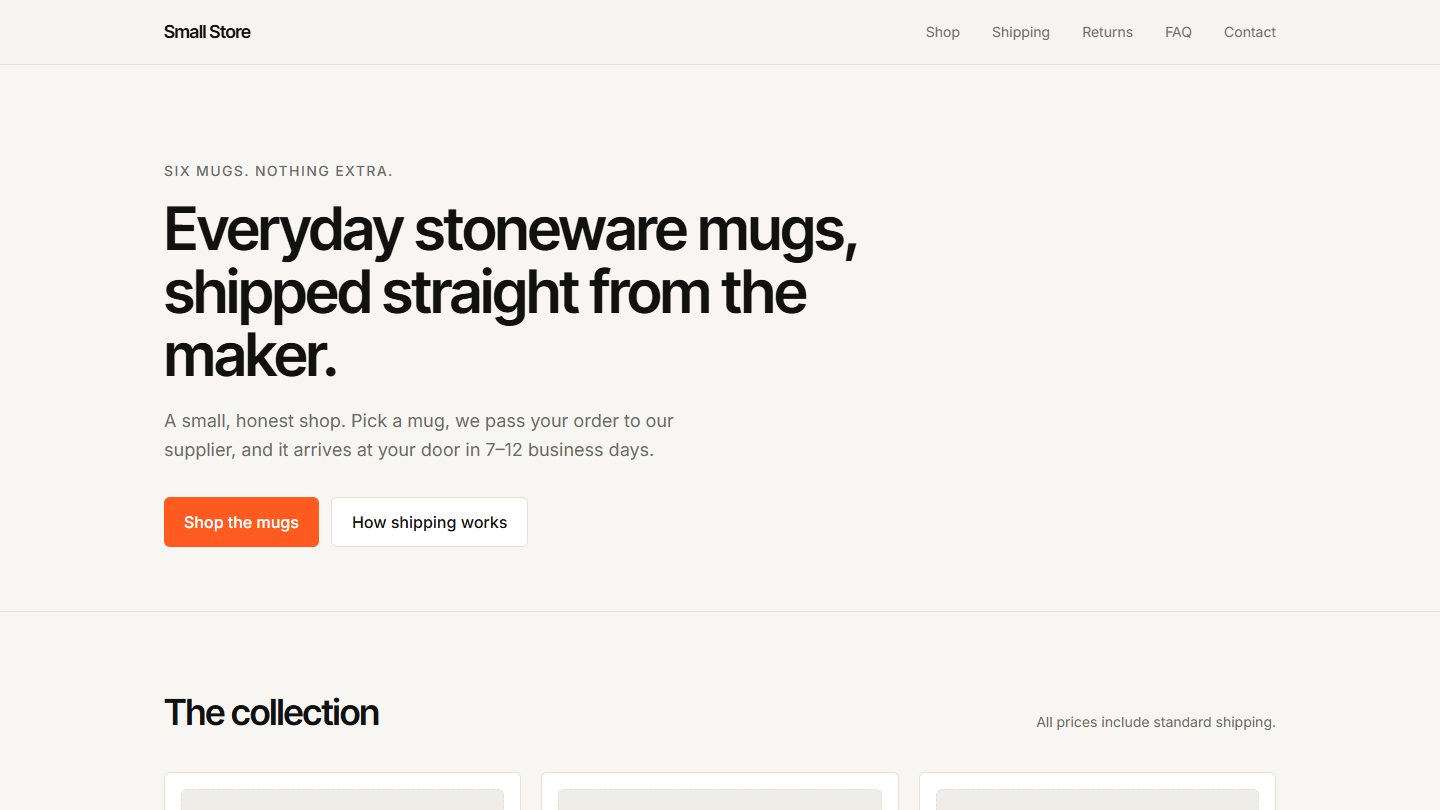
Small dropshipping store. A store for one kind of product that ships straight from the supplier, with honest delivery times and a clear returns policy.
- TIME TO A FIRST VERSION
- About 2 minutes (129 seconds, one build)
- COST TO A FIRST VERSION
- 1 build (a Free account has 3)
- DIFFICULTY
- Medium
- BEST FOR
- People who want to test selling a product online without holding stock
How to start a dropshipping business: the first steps
- 1.Pick one kind of product. A store about one thing for one kind of buyer is easier to explain and to advertise than a general shop. Choose products you can judge the quality of.
- 2.Find a supplier and test them. Order the products yourself before you sell them. You will see the real delivery time, the packaging and what a return involves.
- 3.Do the sums per order. Your price has to cover the product, shipping, payment fees, returns and what it costs to find a customer. If little is left, pick another product.
- 4.Build the store. Each product needs honest photos, a clear delivery time and a returns policy. Say plainly that items ship from the supplier.
- 5.Get the first orders. Start with one channel where your buyers already are, and keep answering customers quickly. Slow delivery and silence are what sink most stores.
WHAT COSTS MONEY AT THE START
- Sample orders from suppliers
- Advertising or other ways to reach buyers
- Payment fees, returns and refunds
- A store: a first version takes one build on Conquer
WHAT YOU NEED
- One or two suppliers you have ordered from yourself
- A payment account
- A returns and delivery policy in plain words
- A store with a page per product
Amounts are left out on purpose: they differ by country and change. Rules on registration, insurance and licences differ by place too, so check your own.
The problem
Someone who wants to sell products online does not want to buy stock before knowing whether it sells. Shoppers, in turn, distrust stores that hide where items ship from and how long they take.
“The biggest issue I found when I tried dropshipping around a year ago, was the insanely long shipping times.”
How many customers look for this
Searches by people who want to buy what this business sells: a sign of demand from your future customers.
| SEARCH | PER MONTH |
|---|---|
| ceramic mugs | 14,800 |
Average monthly Google searches in the United States, from OpenSEO (November 2026). A "near me" search counts every town, so one town sees a small share of it. Similar searches overlap, so do not add them up.
What people use today
- Shopify. Hosted online store builder with monthly plans and apps for connecting suppliers.
- WooCommerce. Free, open source store plugin for WordPress; hosting, extensions and upkeep are your own.
- Marketplaces such as Amazon and eBay. Bring buyers, charge fees per sale that vary by category, and put your listing next to competitors.
Should you build this?
REASONS TO BUILD IT
- No stock to buy before the first order.
- A store about one kind of product is quick to set up and easy to explain.
REASONS NOT TO
- Margins are thin once shipping, fees and returns are paid.
- You answer for the supplier's delivery times and quality without controlling them.
How we built it, and what broke
PROMPT 1
An online store for one kind of product that ships straight from my supplier. The home page shows six products with a plain placeholder box where my own product photo will go, a price and a short description each. Each product opens a page with details, the delivery time and a buy button. Add a section that says plainly that items ship from the supplier and how long delivery takes, a returns policy, common questions and a contact form.
Built first time in 129 seconds with no repair, in 16 files and Conquer's Signal style: a home page with six products, a page per product with details, the delivery time and a buy button, and sections on supplier shipping, returns, common questions and a contact form.
- The prompt names no product, so the AI used ceramic mugs as the example, with sample prices and delivery times: swap in your own.
- The buy buttons say “Coming soon” until Stripe is connected and the products have a price.
Where to find the first customers
- One community around the product. Be useful there first, and share the store when someone asks where to buy.
- Short videos of the product in use. Show the real item you ordered yourself, with the link.
Last updated . Competitors and market notes are a starting point for your own research, not advice.
More business ideas
- SHOPSOnline store for a small clothing brandA small clothing brand's store with a collection page, product pages with sizes and a size guide.EASY TO BUILD · WORKING EXAMPLE
- SHOPSOnline shop for handmade jewelryA jewelry maker's shop with collections, product pages with materials and a form to book a permanent jewelry event.EASY TO BUILD · WORKING EXAMPLE
- SHOPSOnline shop for handmade candlesA candle maker's shop with scents, product pages with burn time and wax, and a form for custom or wholesale orders.EASY TO BUILD · WORKING EXAMPLE